📌 How Small Business Valuation Works (Quick Answer)
Small business valuation in 2026 centers on normalized earnings multiplied by an industry multiple. Most owner-operated firms earning under $2M use Seller's Discretionary Earnings (SDE) – net income plus owner salary, benefits, depreciation, and discretionary/one-time expenses – while larger or professionally managed firms use EBITDA. Core formula: Valuation = Normalized Earnings × Industry Multiple.
💡 This deep-dive guide focuses specifically on the SDE and EBITDA multiples methodology used in 90%+ of Main Street transactions. For a high-level comparison of all three traditional methods (Asset-Based, Market Multiples, and Income/DCF), explore our foundational Business Valuation 101 Overview.
The $280,000 Mistake: Why Tax Returns Lie About Business Worth
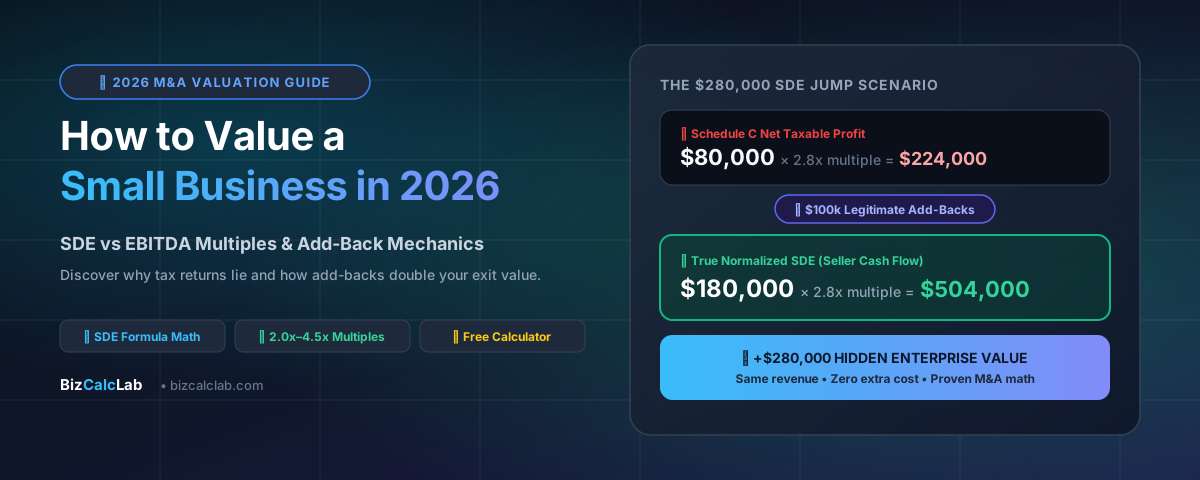
Imagine you have spent eight relentless years building a local service company or e-commerce brand. An interested buyer approaches you and asks for your last three years of tax returns. You look at Line 31 of your Schedule C (or Form 1120-S) and see a net taxable income of $80,000.
Your heart sinks. A standard 2.8x multiple on $80,000 puts your business valuation at a modest $224,000. You wonder if eight years of 60-hour workweeks were really only worth the price of a mid-tier SUV.
Here is the secret professional M&A brokers know: Tax returns are intentionally structured by your CPA to minimize taxes, not to showcase true economic earning power. To reveal what your business is truly worth, you must normalize your cash flow into Seller's Discretionary Earnings (SDE).
The Statutory SDE Add-Back Formula
SDE represents the total financial benefit a single full-time owner-operator derives from the business. Follow this standard normalization workflow:
📋 The Complete SDE Calculation Formula
SDE = Reported Net Income
+ Owner's Full Salary, Draws & Bonuses
+ Owner Health Insurance & Retirement Perks
+ Depreciation & Amortization (Non-Cash)
+ Interest Expense on Business Debt
+ Documented One-Time Expenses (Non-Recurring Legal, Facility Repairs)
+ Personal Discretionary Expenses (Owner Vehicle, Cell Phone, Travel)
A business reports $80,000 net income on tax returns. Legitimate add-backs total $100,000 ($70,000 owner salary/benefits + $15,000 non-cash depreciation + $15,000 one-time legal fees and discretionary perks). True Normalized SDE = $180,000.
- Unadjusted Valuation (2.8x on $80k Net Income): $224,000
- Normalized SDE Valuation (2.8x on $180k SDE): $504,000
Proper normalization creates an instant $280,000 gain in enterprise value at the exact same market multiple!
Normalize Your SDE and Find Your Valuation
See exactly how your owner add-backs and 2026 industry multiples change your enterprise value. Free, no email required.
📊 Run the Business Valuation Calculator →2026 Small Business Valuation Multiples by Sector
What multiple should you apply to your SDE? Below are closed-transaction benchmark ranges for owner-operated small businesses under $2M in annual revenue:
| Business Sector | Typical SDE Multiple | Median SDE | EBITDA Multiple Range | Key Drivers of Higher Multiples |
|---|---|---|---|---|
| E-commerce / D2C Brands | 2.0x – 3.5x | ~2.8x – 3.3x | 3.0x – 5.0x | Brand moat, recurring subscriptions, diversified ad channels, clean inventory tracking. |
| Local Service Contractors (HVAC, Plumbing, Electrical) | 2.0x – 4.0x+ | ~2.6x – 3.5x | 4.0x – 6.5x+ | Recurring maintenance contracts, multi-truck fleet, strong technician retention, owner independence. |
| B2B SaaS / Micro-SaaS | 2.5x – 4.5x+ | ~3.0x – 4.0x | 5.0x – 10.0x+ | High Net Revenue Retention (NRR > 100%), low monthly churn (< 2%), clean IP code transferability. |
| Professional Agencies (Marketing, Design, Dev) | 1.9x – 3.5x | ~2.5x – 2.7x | 3.5x – 6.0x | High retainer revenue %, low client concentration (< 15% per client), documented SOPs. |
| Main Street Retail & Food | 1.5x – 2.8x | ~2.5x – 2.6x | 3.0x – 5.0x | Prime foot traffic location, favorable long-term lease terms, turnkey general manager in place. |
- SDE vs. EBITDA Threshold: Use SDE for owner-operated companies with under $1M in net earnings. For businesses generating $2M+ in EBITDA with full management teams, switch to EBITDA multiples.
- Main Street Average: Across all private small-business sales in the US, the aggregate median multiple rests around 2.5x to 2.7x SDE.
The 4 Value Drivers That Command Top-Tier Multiples
Buyers do not pay top dollar for revenue alone; they pay for low risk and transferability. To command a multiple at the highest end of your industry range, focus on these four levers:
- Owner Independence: Can you take a 30-day vacation without revenue collapsing? If the answer is no, buyers apply a "key-person discount". Document your workflows into Standard Operating Procedures (SOPs).
- Low Customer Concentration: No single client should generate more than 15% to 20% of your total revenue. A company with 50 diverse clients is exponentially safer than one with 2 large accounts.
- Predictable & Contracted Revenue: Recurring monthly retainers and automated subscriptions fetch a 20% to 50% multiple premium over project-based one-off sales.
- Clean Financial Books: Separate all personal expenses from business accounts at least 24 months before listing. Transparent P&L statements expedite SBA 7(a) loan approval for buyers.
Frequently Asked Questions (FAQ)
What is the difference between SDE and EBITDA when valuing a small business?
SDE (Seller's Discretionary Earnings) adds back the owner's full compensation, benefits, and personal expenses to reflect total cash available to a single owner-operator. EBITDA does not add back owner compensation and is used for larger businesses with existing management in place. Using the wrong metric can distort valuation by 30% to 50%.
What multiple is used to value a small business in 2026?
Most owner-operated small businesses under $2M in earnings sell between 2.0x and 4.0x SDE, with the overall Main Street median sitting near 2.5x to 2.7x. The exact multiple depends on recurring revenue, growth, low customer concentration, and how easily the business operates without the founder.
How do you calculate Seller's Discretionary Earnings (SDE)?
Start with net income from your tax return or P&L, then add back owner salary, health insurance and benefits, depreciation/amortization, interest expense, documented one-time legal/repair costs, and personal discretionary expenses run through the business.
Get Your True Business Valuation Today
Your reported net income is only the starting point. Normalize your cash flow and calculate your true worth: